
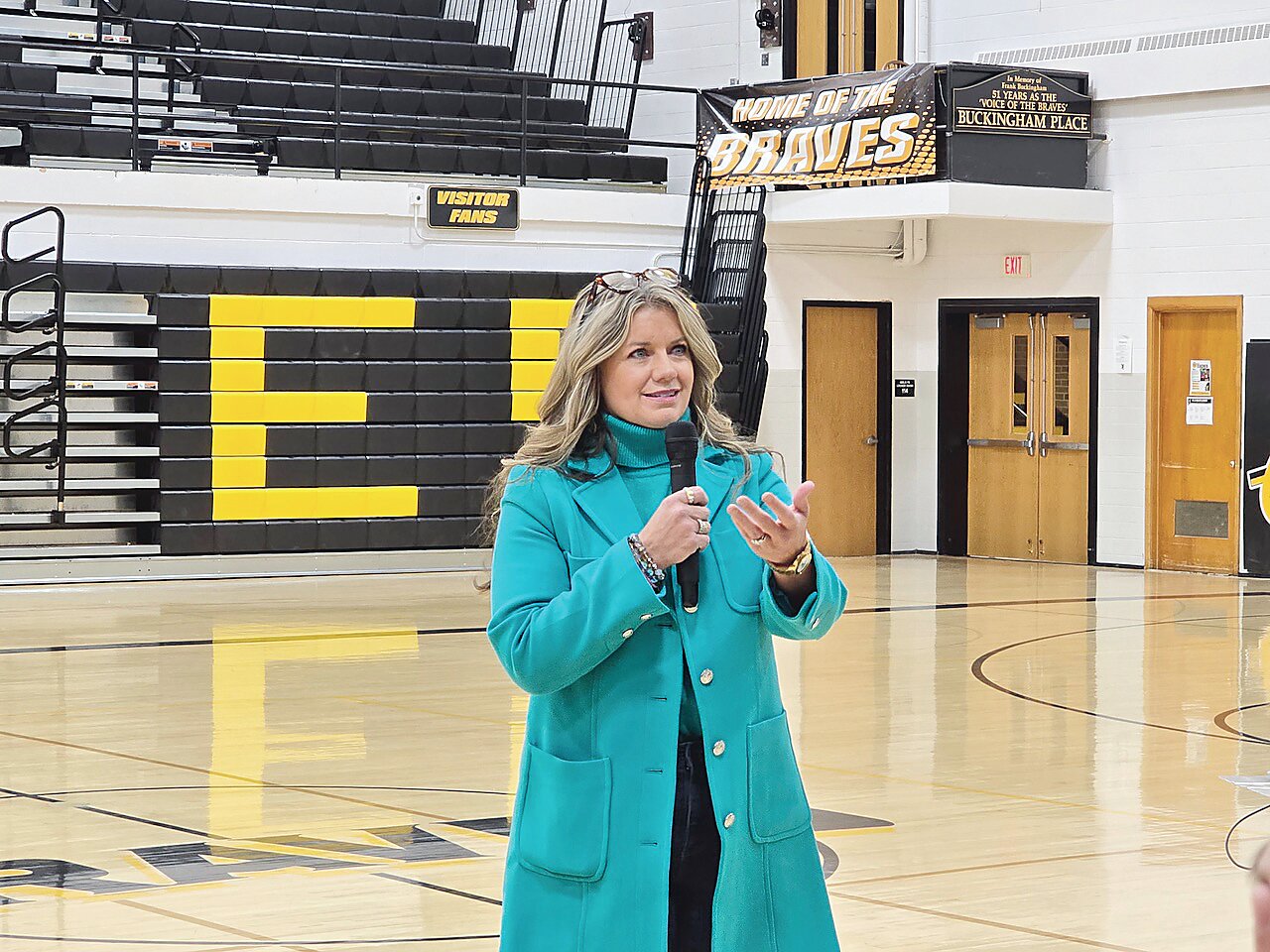
Cherokee School Board member Jocelyn Riggert is concerned about Stacy Besch speaking to underage students in Cherokee.
Riggert asked Supt. Tom Ryherd why he invited the activist speaker from Algona to Cherokee for a second time to show “Gridshock,” a 2019 documentary about Iowa’s reportedly growing human trafficking problem to high school and middle school students. Riggert worried about how Besch plans to contextualize the documentary to students.
“My question is on how it will be presented to the students,” said Jocelyn Riggert at a school board meeting Feb. 17.
Ryherd and the remainder of the school board refused to budge.
“The feedback I received from staff was overwhelmingly positive — what they learned, how impactful it was, and we even had some say our parents and students need to hear this message,” Ryherd told the freshman board member. Board member Brian Freed described Besch’s presentation of the documentary as “very intense, very eye-opening, very good information.”
Besch began showing “Gridshock” at local community centers around two years ago. Her upcoming presentation on Monday will mark her 107th screening and discussion of the documentary, which attempts to reveal the scourge of sex trafficking in rural Iowa towns like Fonda and Carroll. She admits her presentation of the film depicts a “sexually perverted world,” but students age eight to 14 are targets for the sex trafficking industry she says is growing rapidly right here.
“There’s sexual language, but there’s nothing graphic,” Besch said in response to critics of her and the film. “It’s really happening in our backyard, and if you see something, say something because you could save someone’s life.”
She has designs to show the film in 900 communities in the state.
Ryherd: “Having seen her presentation, it is not politically charged”
After the school district announced the upcoming presentations, around half a dozen parents took issue with political messages on Besch’s Facebook page, worried those beliefs might seep into her talk with students.
Steph Zarr, a Cherokee parent with children at the Cherokee Elementary School and chairwoman of the county Democratic Party, worried Besch’s presentation would amount to “fearmongering.” Zarr wonders how Besch is an authority on sex trafficking and how she approached researching the issue.
“I think people are concerned that her extreme political views may come into her presentation,” Zarr wrote on the Facebook group Cherokee Community School District Stakeholders for Accountability, an association that formed after the school board allowed teachers to carry firearms on school grounds. It’s a group primarily comprised of Democrats.
Parents in the group raised objections to a post on Besch’s Facebook profile that conveyed outrage at the former Obama Administration’s protections for transgender people. On Wednesday morning, Besch reposted a video of parents raising non-binary children, stating, “This is child abuse! And we need to write against this and protect these children!”
Her background photo reads “JESUS is my savior. TRUMP is my president.”
Besch smiles next to Donald Trump in her profile photo.
“Regardless of her political stance, if her presentation is on topic and has meaningful and helpful information, that’s fine,” Zarr said. “It’s just that it seems that certain groups are politicizing certain issues to further an agenda. This woman clearly has an agenda.”
Besch insisted her fight against human trafficking is divorced from her personal political views.
“It’s not a political issue, it’s not right or left,” she said. “This is a humanity issue and a moral issue.”
Besch claims internet pornography is the “seed” of sex trafficking in Iowa.
She claims it’s exploding “in our backyard.”
At her events, Besch first screens the film, then shares additional stories from other sex trafficking survivors from small towns in rural Iowa. She also explains signs of trafficking, how to seek help, and elaborates on the “seed” of the issue. Besch tells parents to delete what she calls “dangerous” gaming and social media apps off their children’s devices to avoid susceptibility to traffickers and sexual manipulation.
“Human trafficking is a supply-and-demand issue,” she said. “We wouldn’t need the supply if we didn’t have the demand. The demand is coming from pornography as the seed.”
Besch maintained that children are most vulnerable to online predators around age 10. And, she said, that’s around the age when boys begin to view and share pornographic materials.
“These boys are encouraging these girls to take nude pictures, and that goes along with pornography,” Besch said. “If somebody is addicted to porn, they are more apt to become a (trafficker) someday.”
Besch says she asks students, “how many of you have watched porn on your phone or know somebody who has?”
She claims that every time, “every single student raises their hand.”
Besch asks students to take photos of her lists of resources at the end of every presentation: she provides information on “safe houses” for survivors of human trafficking and domestic violence, hotline call numbers, recommendations for other movies and books and a list of the “top 10 most dangerous gaming apps” in which children could fall victim to online predators.
Besch tells parents to delete apps like Snapchat, Roblox and Discord from their children’s devices.
“I always tell parents, ‘You’re there to protect, not to be their friend,’” Besch said. “If you’re not going to take these away from your kids, you might as well just put them in the middle of a highway because that’s about as dangerous as it can get for them, you’re making them an easy target.”
Besch is scheduled for two screenings on Sunday and Monday.
She’ll speak to parents and community members at the Cherokee Washington High School Auditorium Sunday. The next day, middle and high school students will attend the same presentation.
Besch hopes attendees learn that human trafficking often occurs in unexpected places and by unexpected perpetrators. She claims only 8% of human trafficking cases are considered abductions, while 92% are “more than likely through the phone.”
It’s unclear where Besch obtained the statistic. She said she “doesn’t get any of the information from Google.”
Besch ensures to tell every audience that per capita, Iowa has the third-highest rate of human trafficking in the nation. She said she garnered that statistic from three experts in law enforcement: Ray Fiedler, a special agent with the Iowa Division of Criminal Investigation, and Greg Hall and David Gonzalez, investigators with Hope for Justice, a “charity working to bring freedom from human trafficking and modern slavery,” according to the organization’s website.
Vanessa McNeal, an Iowa State graduate and “Gridshock” documentarian, said she couldn’t verify Besch’s claim about the per-capita prevalence of sex trafficking in Iowa.
McNeal said she’s unsure of how Besch gathered information for her talks.
“My objective was to put out the documentary as an educational tool, to raise awareness,” McNeal said. “I can’t confirm that stat or where she got it, I’ve never seen it.”
McNeal met Besch briefly last year to discuss her documentary. Through Team Iowa, a “group of Christian patriots” affiliated with Team America, Besch purchased an educational license to show the film.
McNeal said this week a Cherokee resident sent her photos of Besch’s Facebook posts. One excoriates families who raise non-binary children, among other politically charged posts.
“I didn’t know until this week the depths of her political and social views,” McNeal said of the online interaction with the Cherokee resident. “I don’t endorse any of those, and I don’t want the film to be associated with any of her views about the LGBTQ+ community or politics at all. This is not a political issue.”
Besch maintained that McNeal’s film continues to inspire her activism against human trafficking and sexual assault. The documentary highlights testimonies from survivors, state prosecutors, law enforcement and a recovering pornography addict.
“I share their stories so that people can learn from them,” said Besch, who claims she’s spoken with dozens of survivors. “And that’s what they want — for people to hear their story so they can help protect someone else.”
Ryherd also assured that Besch’s discussion with students will be without political bias.
“Having seen her presentation, it is not politically charged,” he said. “I’m strictly looking to inform our community, our parents, our kids about the threats and dangers of human trafficking. That’s it.”
Riggert, the concerned school board member, worried about the district’s stance on showing “Gridshock” alongside Besch’s presentation without age restrictions.
She pointed to an October showing at Eastern Iowa Community Colleges that limited attendees to 16 and older. And she asked whether Besch would modify her remarks for middle and high school students.
“As far as her narrative with students, it will be tamped back a little bit, but not so much that she can’t get her point across,” Freed responded. “It’s going to remain about human trafficking.”
Hence the showing on Sunday at 6 p.m. If parents have a problem with the film and Besch’s presentation, they can ask that their child not attend the presentation on Monday, Ryherd explained.
“We were adamant about giving parents an opportunity to view it first,” Ryherd said. “We’re giving parents the opportunity to make the parental decision of whether they feel it’s appropriate.”
Riggert declined to comment on her questions or stance on the appropriateness of the film after the school board meeting Feb. 17. She directed requests for comment to Jodi Thomas, school board president. Thomas also declined to speak about the issue, stating that the school board agenda did not provide for a discussion on Besch’s events.
“I was caught really off-guard by her question in a way that I probably shouldn’t have led a discussion about that during the meeting,” Thomas said Monday.
Ryherd said the district has already twice notified parents of the scheduled presentations and “strongly encouraged” them to attend on March 2.
The documentary is also available for purchase online for around $5.
Ryherd said students who abstain will have alternate activities in the classroom at the discretion of the individual teacher.
“We really want to make sure parents know they have that right.”


Comments
No comments on this item Please log in to comment by clicking here